As part of our research process for each focus sector, the YEG Connect Project, under the Edmonton Region Immigrant Employment Council (ERIEC), hosts forums with relevant stakeholders and employers. During our care economy research, we had the opportunity to chat with Monica Das from PALS.
What began as a volunteer role from a friend’s referral in the late 1990s evolved into a student summer position, eventually leading Monica Das to the Executive Director role at PALS in 2019. Das has a lived understanding of the immigrant experience in Canada: arriving to a new country, seeking opportunities, navigating unfamiliar systems and workplace cultures, and stepping out of her comfort zone to pursue job prospects, even when it felt uncertain.
“I didn’t know how things worked in Canada when I started volunteering, but I asked my volunteer manager Shirley about applying for the coordinator role. The role appealed to me because I enjoyed meeting new people, matching them with programs, and engaging in outreach to different places. Shirley encouraged me to apply,” she says.
Das emphasized the profound impact that Shirley, the Executive Director at PALS at the time, had on her career, highlighting the vital role employers play in the success of international employees and newcomers in the Canadian workplace.
“I owe much of my passion for this work to her belief in me,” Das says.
When Shirley sadly passed away in August last year, the board invited Monica to step into the Executive Director role. She embraced the opportunity to lead, grow, and shape the organization, held by the confidence, knowledge, and trust that Shirley had placed in her.
As a newcomer, Das initially had the same mindset many newcomers have: You don’t question your boss; you just do the work. Through working with Shirley, Das began to understand that respectful challenge and presenting new ideas to tackle familiar tasks can be part of a healthy workplace.
“When I worked with Shirley, I learned that it was okay to ask questions and offer different ideas. She didn’t agree with everything I suggested, but she gave me space to speak up, and our disagreements never damaged our working relationship.”
New hires thrive when employers give them the trust and space to take initiative and execute their ideas. For Das, confidence grew from trust, the chance to try, and the opportunity to demonstrate her skills and experience. That freedom gives newcomers the chance to meet challenges with fresh, innovative approaches.
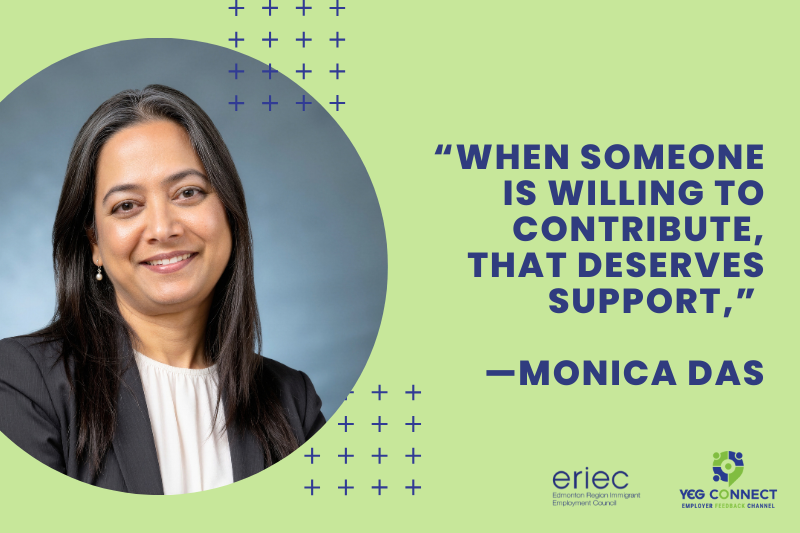
“When someone is willing to contribute, that deserves support,” she says.
As an immigrant navigating the Canadian workplace, Das learned by watching how others worked, how they handled tricky situations, and by asking questions whenever something wasn’t clear. In her recent work with newcomers, she emphasizes looking beyond your supervisor, as there is a whole workplace to learn from. The way people interact, collaborate, and problem-solve can teach newcomers more than any single job description ever could.
In her role as Executive Director, from which she has recently retired, Das focused her hiring efforts on finding candidates who were willing to learn and eager to grow and embraced taking “chances” on newcomers who showed that potential, even if they didn’t meet every job requirement on paper.

“I did not hire immigrants just because they were immigrants. I hired based on whether the person could do the job and whether I could teach them the skills they need to learn,” she says.
When PALS had an opening for an office assistant in 2021, they received many applications with more than half from newcomers who were overqualified for the role. One resume stood out to Das: The applicant had a master’s in accounting from India, previous university work experience, and was not employed at the time, but she struggled to communicate clearly in English during the interview.
Rather than discounting her qualifications because of the language barrier, PALS considered her full background and recognized her potential. They hired her at the same salary they would have offered for the role while building daily conversation classes into her work schedule alongside training on PALS’s accounting system. The position gave her opportunities to strengthen her English through front-desk interactions while contributing the accounting skills and experience she already brought to the organization.
After six months, PALS supported her in enrolling in post-master’s studies, and within a year, she took over bookkeeping and was promoted to executive assistant.
Workplaces and newcomers thrive when employers look beyond barriers and have the capacity to accommodate, evaluate core skills, and see a candidate’s true value. Actively supporting newcomers in closing their learning gaps unlocks their full value and drives mutual success.
YEG Connect, led by the Edmonton Region Immigrant Employment Council (ERIEC) is part of a national coalition of Immigrant Employment Councils (IECC), working together to simplify and strengthen the process of hiring newcomers and internationally trained professionals. Funded by Immigration, Refugees and Citizenship Canada, YEG Connect aims to make it easier for employers to recruit the skills, experience, and diverse perspectives of immigrants while helping build a more inclusive Canadian workforce. We also thank the Government of Alberta for funding our regional hub.