
Chris Milne manages the Employer Services branch at Opportunities for Employment (OFE), an employment service provider connecting job seekers with employment in Winnipeg, MB. OFE has operated for nearly 30 years and places around 2,000 people into employment every year. Over the last decade, OFE has transformed how they provide employment services. Rather than follow traditional pathways, like helping job seekers upgrade resumes or enrolling them in computer training or skills-upgrading classes, OFE has evolved to provide demand-led training and career guidance.
“We let the labour market dictate what needs to be done to meet labour demand,” says Chris. “We found that approach to be much more efficient.”
This shift manifests in the way OFE serves job seekers (including newcomers) today, especially those who have only a vague idea of the type of work they want to do. Rather than making job seekers spin their wheels in career exploration classes, OFE provides them with a menu of options by listing partner companies who are hiring.
“That is usually when people’s curiosity kicks in, and they might consider an occupation they’ve never thought of before one that’s in demand. This way, they’re not chasing jobs where there are no vacancies,” says Chris.
At any given time, OFE has between 700 and 800 people looking for work through the organization, most of them underrepresented in the labour force as mature workers, persons with disabilities, or people on social assistance. In the last year, about 63% of OFE’s job seekers identified as newcomers, making up the largest demographic that OFE serves.
Previously, OFE’s employment services involved gathering as much information as possible about a job seeker’s work history, skill sets, education, and job goals, then tailoring their resume and creating mock interviews to prepare them. However, it was up to the job seeker to secure the work. Today, that approach has changed.
“We thought maybe we could provide more assistance by actually making the connections, especially with newcomers, since about 85% of jobs are secured through networking, and newcomers often don’t have those networks here,” says Chris. “They might have their community, but outside of that, they just don’t have the connections others do.”

Rather than enforcing a strict resume and interview process, OFE’s employer partners welcome candidates to visit the workplace and participate in relevant activities that expose them to the job’s tasks. OFE coordinates a time for the candidate to meet the employer on-site and demonstrate their motivation and skill set by trialling the tasks of the job.
“If I’m a job seeker who just meets someone in an office for an interview, I have no idea what’s behind the door in the workplace. I may hate it, but I don’t know; I’m just sitting in an office with a stranger,” says Chris.
Chris shared an example of one of their partner furniture manufacturing companies that hires new employees through OFE. Instead of submitting a resume or completing an interview, candidates are placed at a workstation with different tools, have each tool explained to them, and are then asked to use the tools to make a small item.
This hands-on approach reduces the risk for both the candidate or employee and the employer by:
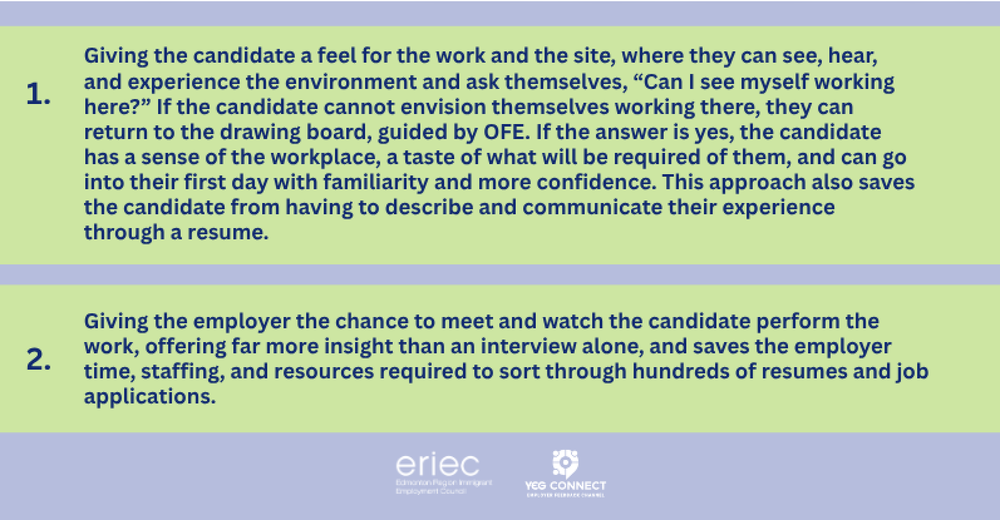
After adopting this new approach to providing career services, OFE saw two things happen: Training retention increased because candidates had a tangible goal at the end of the training, and training engagement, commitment, and retention skyrocketed.
This is not to say an employer’s role in employee onboarding ends there, particularly when employees are newcomers and unfamiliar with Canada’s workplace culture. Chris emphasized the importance of employers providing training on workplace culture and unwritten workplace rules so new hires have the necessary context to understand work operations. Skilled workers have much to contribute but may benefit from support in bridging cultural and workplace gaps.
“When you see a potential employee make the commitment to come and do a practicum or some sort of assessment, an employer can see their motivation and dedication to the job, along with witnessing that they can do the job. That checks off two of the three boxes right away, something that a simple resume review can’t do,” says Chris.
YEG Connect, led by the Edmonton Region Immigrant Employment Council (ERIEC) is part of a national coalition of Immigrant Employment Councils, working together to simplify and strengthen the process of hiring newcomers and internationally trained professionals. Funded by Immigration, Refugees and Citizenship Canada, YEG Connect aims to make it easier for employers to recruit the skills, experience, and diverse perspectives of immigrants while helping build a more inclusive Canadian workforce. We also thank the Government of Alberta for funding our regional hub.